
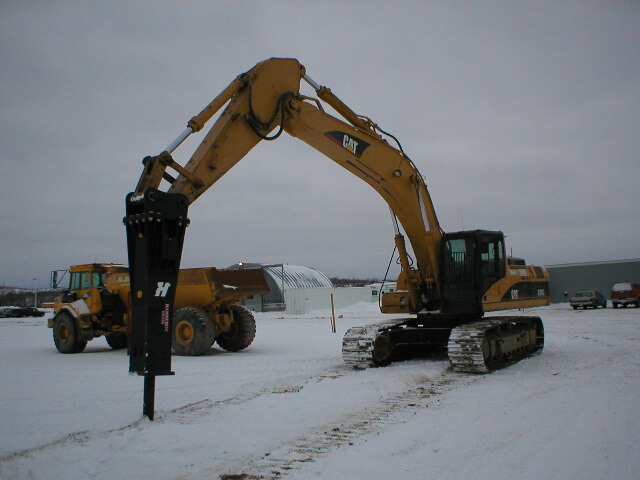
Hydraulic Hammer Winter Warmup and Storage Tips
Our Gorilla Service Team tends to get a lot of leaking hydraulic hammers of all makes and models on the coldest of days. The seals in all hydraulic hammers are made out of rubber/plastic/polymers. When the breaker is cold, these seals become rigid and inflexible. Hydraulic fluid is also not as effective when cold. It loses viscosity, which reduces its ability to provide an effective film to protect internal components. If you run a hydraulic breaker dead cold, you are more prone to the seals cracking and causing a leak. The lack of film between the hard internal components can cause premature wear of the cylinder, piston, valve, and other components.
Warm-up Procedure for Hydraulic Breakers
BEFORE you fire the hydraulic hammer
- Idle your machine as you usually would to warm up the engine.
- Exercise the functions on the machine to heat the hydraulic oil
- Lift and lower the boom, move the stick in and out, curl and uncurl the bucket, swivel the machine, etc. without engaging the ground
Once hydraulics are warmed up
- Make sure the stick shutoff valves to the hammer are OPEN
- Run the hydraulic hammer at half RPMs/half throttle for the first 30 minutes to allow the hammer hydraulics/auxiliary hydraulic circuit to warm up
- After the warm-up period, operate your hydraulic breaker as you usually would, not cycling the hammer continuously for more than 20 seconds at a time, and lubricating it every two hours with chisel paste.
Hydraulic Hammer Storage
There is a high frequency of all makes of hydraulic breaker repairs that come in during the spring. Of course, some are attributed to a return to regular use in temperate areas. However, upon disassembly, we often find that the cause of the leak is water damage to the piston and/or cylinder of the hydraulic hammer. Hammer seals are primarily designed to keep oil in, not to prevent water intrusion. Steps can be taken to avoid such needless damage and expensive repairs.
General rule
- Never store a hydraulic breaker outside in a horizontal position.
On the carrier
- Keep it vertical.
Off the carrier
- Make sure hoses or flanges are properly capped or plugged. No red rags!
- If you have a solid, safe stand, place the hammer in it when not being used
- The best stands allow the piston/tool to “drop” or “rest”, which relieves pressure on the hydraulic hammer’s nitrogen chamber
- If you don’t have a stand, at least SAFELY chain it and lean it against something solid to keep as steep a vertical angle as possible.
- If you MUST store it horizontally outdoors, at least SAFELY place a solid block under the head bracket to achieve a downward angle and place a tarp over it
Contact Gorilla Hammers for All Your Hydraulic Breaker Needs
If you have any questions about these or any other hydraulic breaker topics, please don’t hesitate to reach out to our expert team. Contact one of our trained team members at 1 (888) 814-6745, and we’ll be happy to provide the guidance and support you need!